

How To Install Sterling Bathtub Surround
How to Install a Bathtub: Install an Acrylic Tub and Tub Environs
Updated: Mar. 09, 2022
Remove an old plastic bathtub and environment and install a new bathtub and three piece surround with new plumbing and a tile edge.

In this story, we'll walk you through a basic installation process, beginning with what is frequently the toughest part—trigger-happy out the one-time tub and shower. And then we'll show you lot how to install and replumb the new unit. And finally, nosotros'll testify you lot a tiling technique that simplifies the finish work and makes the entire installation look dandy.
Yous might also similar: TBD
- Time
- Complication
- Cost
- Multiple Days
- Intermediate
- $501-1000
Planning
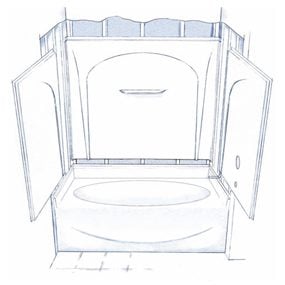
Effigy A: Iv-piece bathtub/shower
Typical four piece tub/shower kit including tub, two end panels and back wall console
An acrylic tub and shower environment may non accept the sex appeal of an enameled cast iron tub and an elegant ceramic tile surround, only information technology's a lot easier to continue clean and looking spotless. Information technology wipes off quickly and has few joints to catch mold-attracting dirt and scum. And the unit is much easier to install. Most models consist of a tub plus iii shower wall panels, which all interlock and seal. It's the perfect item for a weekend bathroom upgrade. (OK, a full weekend.)
In this story, we'll walk you lot through a basic installation process, outset with what is ofttimes the toughest office—vehement out the old tub and shower. Then we'll show you how to install and replumb the new shower. And finally, we'll testify you a tiling technique that simplifies the finish work and makes the unabridged installation look great.
This projection is a bit circuitous for a beginner. You should accept some experience working with plumbing (P-traps and/or faucets) and basic carpentry tools. If you supercede the shower valve and have copper supply lines, you'll need soldering skills. Our tub/shower unit cost $300 ("Acclaim" by Sterling), and other materials (new shower valve, tile, etc.) cost well-nigh $200. This price tag could easily double with a higher priced tub and surroundings and fancier valves. If y'all do information technology yourself, you'll save the $one,000 cost of professional person installation.
Begin by measuring the guess length and width of your existing bathtub. Permit about 3/4 in. extra at each wall and your measurement should be close to one of the standard tub sizes. Virtually are 5 ft. long and 30 in. wide and are designed to fit confronting the wall studs (Figure A). And so store for tubs and surrounds at dwelling house centers or kitchen and bath specialty stores. Then order your tub. Acrylic replacement tubs are lite enough for one person to lift in and out, fifty-fifty in tight spaces. But beware of i slice bathtub shower surrounds and one-piece tub/shower stalls. They're unremarkably besides bulky to get into an existing bath. Besides option upwardly a new drain and overflow associates (Effigy B), articulate silicone kitchen/bath caulk and the other materials shown in the photos. This is besides the perfect time to replace the old shower valve, spout and shower arm.
Remove the tub faucet and shower head
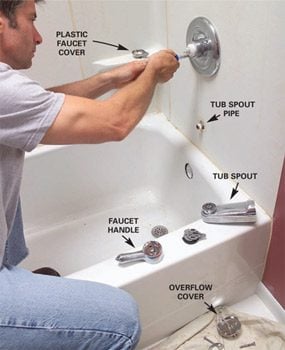
Photo 1: Remove the faucet, tub spout and shower head
Pry the plastic cover off the faucet and remove the screws that concur the handle and trim plate. Unscrew the tub spout and tub overflow encompass.
Before beginning, spread a thick sail dropcloth over the bathroom floor and any nearby fixtures. Notice the shutoffs for the tub—usually behind an access console in an next room—and plough off the water. Then turn the tub faucet on to make sure the shutoffs really work. If water continues to baste out, plough off the main water supply and replace the shutoffs. (Hither are details on replacing the shutoff valves.) Now remove the faucet hardware (Photograph ane). Most faucets are held by screws. Wait for an Allen spiral in a recess under the tub spout. If it doesn't have one, it's probably a spout that you unscrew (counterclockwise) with a pipe wrench. Wrap a rag around the jaws if y'all're planning to salve or reuse the spout. Unscrew the shower arm with the pipage wrench too.
Tear out the erstwhile bathtub environs
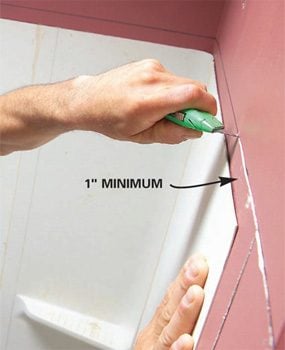
Photo 2: Cutting through the drywall
Cut the drywall slightly outside the edge of the former surround. Utilise a utility knife with a sharp blade and score several times until the blade slices completely through.
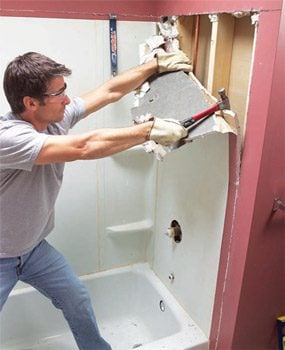
Photo 3a: Pull the drywall and tub environment from the studs
Pull off the drywall with a hammer and pry bar, working from the edges. Keep an eye out for wires and pipes. Habiliment safety glasses!
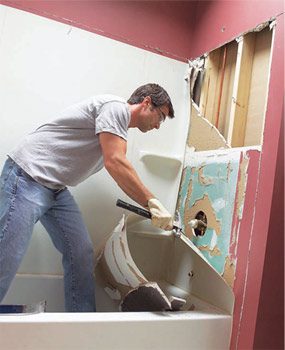
Photo 3b: Pull the tub surround away carefully
Go on your arms and face up clear of sharp edges
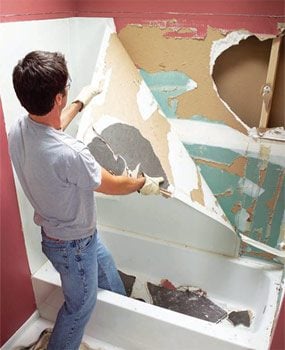
Photograph 3c: Tear out the back department
Pull the tub surround panel costless if the drywall is stubborn, then go back and remove the drywall.
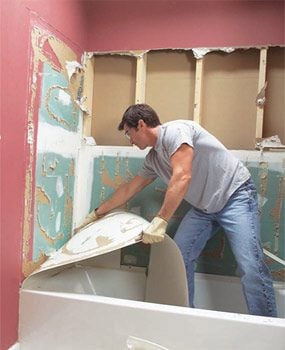
Photo 3d: Remove the final panel
Remove the cut out drywall after pulling away the last pane. Remove any screws or nails from the exposed studs.
To reduce hassles later, cheque the dimensions of the new tub surround (including the nailing flanges) earlier you lot cut out the quondam surround or tile wall. And so brand your cuts about 1 in. larger than the "rough-in" dimensions of the new tub surround (Photo 2). Cutting through the drywall around the tub and downward to the base trim. Comprehend or disconnect the tub drain to keep the waste matter line from filling with debris. The utility knife scoring method we show takes some strength, but it avoids the problem of cut into insulation and hidden wires and pipes. If you utilize a drywall or keyhole saw, cut carefully and continue the cutting shallow.
Many older tub surrounds are glued to drywall, as ours was. If and then, pull out the old drywall and surround with a hammer, pry bar and your hands, starting at the pinnacle and working down (Photos 3a, b, c and d). This also works for tile over drywall or backer board. Wearable a grit mask if the drywall is moldy or y'all're destroying old plaster. If the erstwhile environment was screwed into place, only back out the screws.
Remove the former bathtub

Photo iv: Disconnect the waste lines from the tub
Open the admission panel in the adjacent room and loosen the slip basics connecting the quondam overflow and drain to the trap. Use slip-articulation pliers, if necessary.
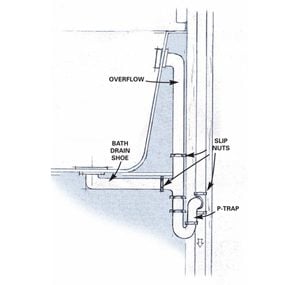
Effigy B: Drain details
Remove the overflow and bathroom drain shoe from the old tub.
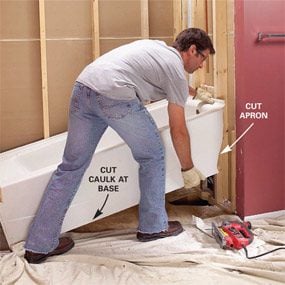
Photo 5: Lift 1 end and remove the tub
Cutting the apron at one end (plastic tubs) with a jigsaw, piece the caulk along the flooring, remove any fasteners, and lift the tub up and out.
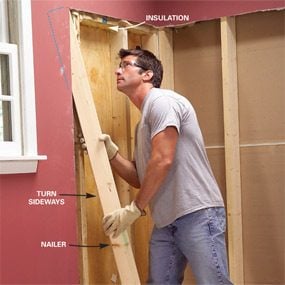
Photo 6: Install 2×4 nailers
Cutting ii×4 nailers the length of the opening, slip them backside the drywall edges. Bulldoze 1-ane/iv-in. screws through the drywall to anchor them. Restore the insulation and vapor barrier.
To disconnect the drain lines, remove the access panel in the neighboring room that gives access to the plumbing. Unscrew the tub drain and overflow where it joins the P-trap (Photo 4 and Effigy B). If the old waste product and overflow connections are stuck, cut them with a reciprocating saw or hacksaw and unscrew the stubs later when the tub is out. Replace old metal traps with new plastic ones. If you plan to replace the shower valve, remove it now.
It's unremarkably hard to get an old tub out in 1 slice. With a fiberglass or acrylic tub, cut out a clamper with a jigsaw and elevator out the tub (Photo v). Steel tubs are tougher; y'all may take to remove drywall and slide them out, although you lot can often tip them up and out too. Cast iron tubs are too heavy to lift out. Intermission it up with a sledge. You lot have to slide in new cast iron tubs.
Remove any moldy insulation and add new 2×iv nailers as needed to back up drywall edges and the new tile backer that you'll add later (Photograph 6). Anchor these with screws driven through the drywall. It's non usually necessary to blast them to solid framing. But don't add nailers at the bleed end of the tub until the new tub is in. You lot may demand the actress wall space when you're tipping in the new tub.
If you have mold, scrub it away and let the expanse dry out thoroughly earlier covering it with insulation and a vapor bulwark.
How to supplant a bathtub
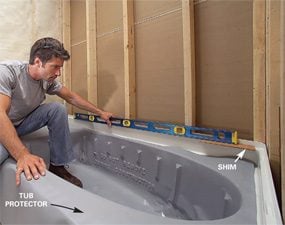
Photograph 7: Cheque for tub level
Set the new tub into place and cheque information technology for level. Figure the shim size needed to level it, and so remove the tub and tack the shims at the tub leg positions.
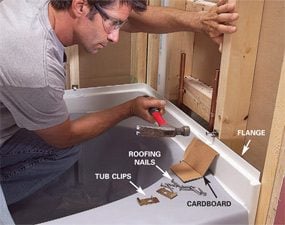
Photo 8: Fasten the tub to the studs
Fasten the tub to the studs. Shim gaps between the studs and the flange to avoid stressing the rim. Protect the tub with heavy paper-thin equally y'all smash
Unpack the new tub and set it into place. Before you lot brainstorm the bathtub installation, check the tub rim for level, both front to back and side to side (Photo 7). The nailing flanges on plastic tubs are not meant to comport weight, so the tub legs must take solid, level bearing on the flooring. Shim spaces less than 1/2 in. with hardwood, metallic or plastic spacers (don't use softwood for tubs with small legs because the wood will vanquish). For thicker shims, use boards or strips of plywood. Use broad spacers and smash or glue them into place at the leg locations then they won't shift when the tub goes in. On larger tubs, the manufacturer may ask you to set the tub in a wet mortar bed, which will mold to the tub bottom and provide extra back up.
At this bespeak, note how the apron (outer edge) of your new tub meets the existing flooring. Now'due south the time to plan this joint, while you can still remove the tub. If you're lucky, the new tub volition meet the floor almost like the old 1. Only you may have a larger gap, or you may have to trim back the finish flooring to get the tub to fit. Solutions vary with the type of floor you have and the gap size. I solution for a gap is to cover the articulation with a sparse solid-surface or marble threshold strip. Use silicone to glue it to the tub or floor, and caulk the edges forth the tub and floor.
Before installing the tub, add together the new bleed shoe while it'southward notwithstanding easy to get at (Figure B). Lay a thick ring of clear silicone caulk nether the rim, and screw it together following the tub manufacturer'due south instructions.
Then install the bathtub and ballast it to the wall studs as recommended by the manufacturer. Our bathtub used special attachment clips, which we fastened with roofing nails driven simply above the flange (Photo 8).
Tip: Protect your Tub
Make sure to protect the finish of your new tub with paper or paper-thin while you're working. And keep it free of grit and droppings.
How to install the surround
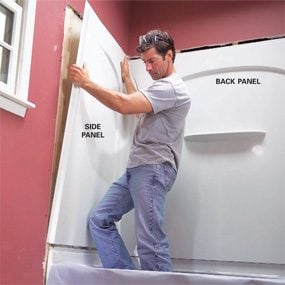
Photograph nine: Ready the back console offset
Set up the back environment panel into place and then gear up the side panels. Chisel off protruding studs and trim the drywall every bit necessary to get a expert fit.
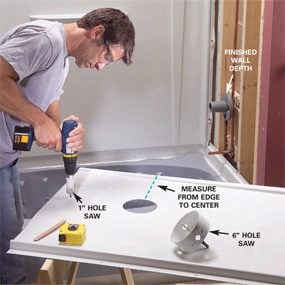
Photo 10: Carefully measure for the faucet and spout
Middle and install the new shower valve and copper lines. Then measure out the exact centers of the tub spout and valve and lay them out on the end panel. Drill the end console holes.
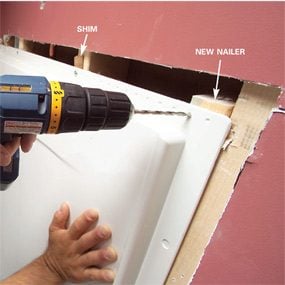
Photo 11: Fasten the panels
Set up the panels and interlock them with the tub and adjust them until the tops are fifty-fifty. Then predrill and fasten the flanges at each stud. Add shims to fill gaps and continue the flange straight.
Ready the back section of the surround on the tub rim, belongings it in identify temporarily with a boom above the peak flange. Then set the side panels (Photograph 9). The manufacturers let a piddling play hither, but not much. Chisel back whatever warped or out-of-plumb studs to keep the panels sitting flat on the tub rim. You can add a shim later if you lot discover a gap (Photo xi). This is where setting your bathtub perfectly level pays off! The panels should marshal inside about i/8 in. If not, recheck your tub for level.
Center the new shower valve on the tub, and solder it in place at the recommended distance back from the finished wall (Photograph 10). Yous may take to shift an onetime valve in or out to fit the new surround.
Reset the dorsum panel and measure to the centers of the valve and the tub spout. Take these measurements twice! Mark those points on the end panel and cut the holes. Hole saws make the cleanest cuts, but you can likewise make the cuts with a sharp one-in. spade bit or a jigsaw (from the back side).
Set up the surroundings panels, locking the corners. If the tops of the panels are within 1/eight in. of each other, tap the high console down gently with a rubber mallet. Otherwise, rework the tub leveling or shave wall studs to get a more perfect fit.
Anchor the panels to the wall with the fasteners specified by the manufacturer. Drive them through slightly oversized predrilled holes (Photo 11). Follow the manufacturer's instructions for caulking.
Finish the walls around the tub
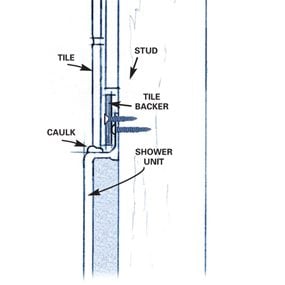
Effigy C: Surround installation item
Make full in above the surroundings carefully for a shine transition to the wall board.
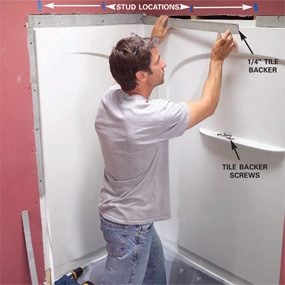
Photo 12: Fill the gaps between the wall and panels
Comprehend the flange and gap with 1/iv-in. tile backer. Predrill oversized holes and drive special tile capitalist screws to avoid breaking the sparse backer board.
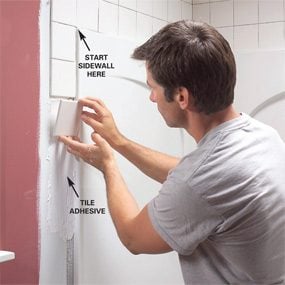
Photo 13: Tile and grout
Tile the back wall first, centering the layout. And then, starting at the outer corner of the cease walls, tile toward the back wall and downwardly to the flooring. Allow the agglutinative set, so apply grout.
Making a dainty wall finish around the new surroundings requires special attention to detail. Because of the thickness of the flange, use 3/viii- or one/four-in. backer board to keep the surface flush with the drywall (Photo 12). In addition, we chose to tile effectually all the edges to comprehend the joint and avert a hard taping task. The sparse backer board is delicate in narrow strips; predrill and spike it to the studs with the special screws designed for backer board. Hold information technology back nearly 1/8 in. from the border of the surround (Figure C).
Clean and prime painted walls before tiling. And then prepare the tile, working from the outside corners on the cease walls and from the center on the dorsum wall for a symmetrical layout (Photo 13). Caulk the tile/tub joint the day after y'all grout.
Install the finished plumbing

Photograph 14: Fit the faucet trim
Attach the cover plate and valve handle. Add together caulk and snug the spout into place
Now end the plumbing. Spread a bead of silicone around the edge of each hole in the environs and install the faucet plate and tub spout. (Avoid bowing the surround inward when tightening.) Cut the new drain line and overflow to length and hook them upwardly to the P-trap and tub. Then run h2o into the tub to test for leaks.
Editor's Note: Dealing with Old Pipes
Finding old steel pipe in the wall doesn't hateful you have to replumb the entire house. You can make a transition from galvanized water supply pipe to copper or plastic (CPVC). For copper, use a special dielectric coupling—a fitting that prevents corrosion. If you lot have steel drainpipes, apply a special "mission coupling" for transitions to plastic drains. All these fittings are available at hardware stores and habitation centers in many sizes.
Required Tools for this Project
Have the necessary tools for this DIY projection lined up earlier you lot start—you'll save fourth dimension and frustration.
Required Materials for this Projection
Avoid last-minute shopping trips by having all your materials ready ahead of fourth dimension. Here's a list.
Originally Published: November 29, 2022

Source: https://www.familyhandyman.com/project/install-an-acrylic-tub-and-tub-surround/
Posted by: beaudinspeausell.blogspot.com
0 Response to "How To Install Sterling Bathtub Surround"
Post a Comment